
Asset Preservation
save the unicorns!

This post could easily double as a campaign to preserve unicorns. Since we agree they exist, then surely we can agree they must be protected. Conserved? Am I a conservationist now? Nah. But am I prancing in that direction? Possibly.
When I find out, you’ll find out.
First, let me define unicorn. Think: early recovery Emily.
Helmet on head, proudly flaunting my “Magical A.F.” unicorn sticker front and center. I wasn’t just wearing it—I was it.
I was blissfully unaware of reality. Nothing could dim my light, stomp on my sparkle, or interfere with my iridescence.
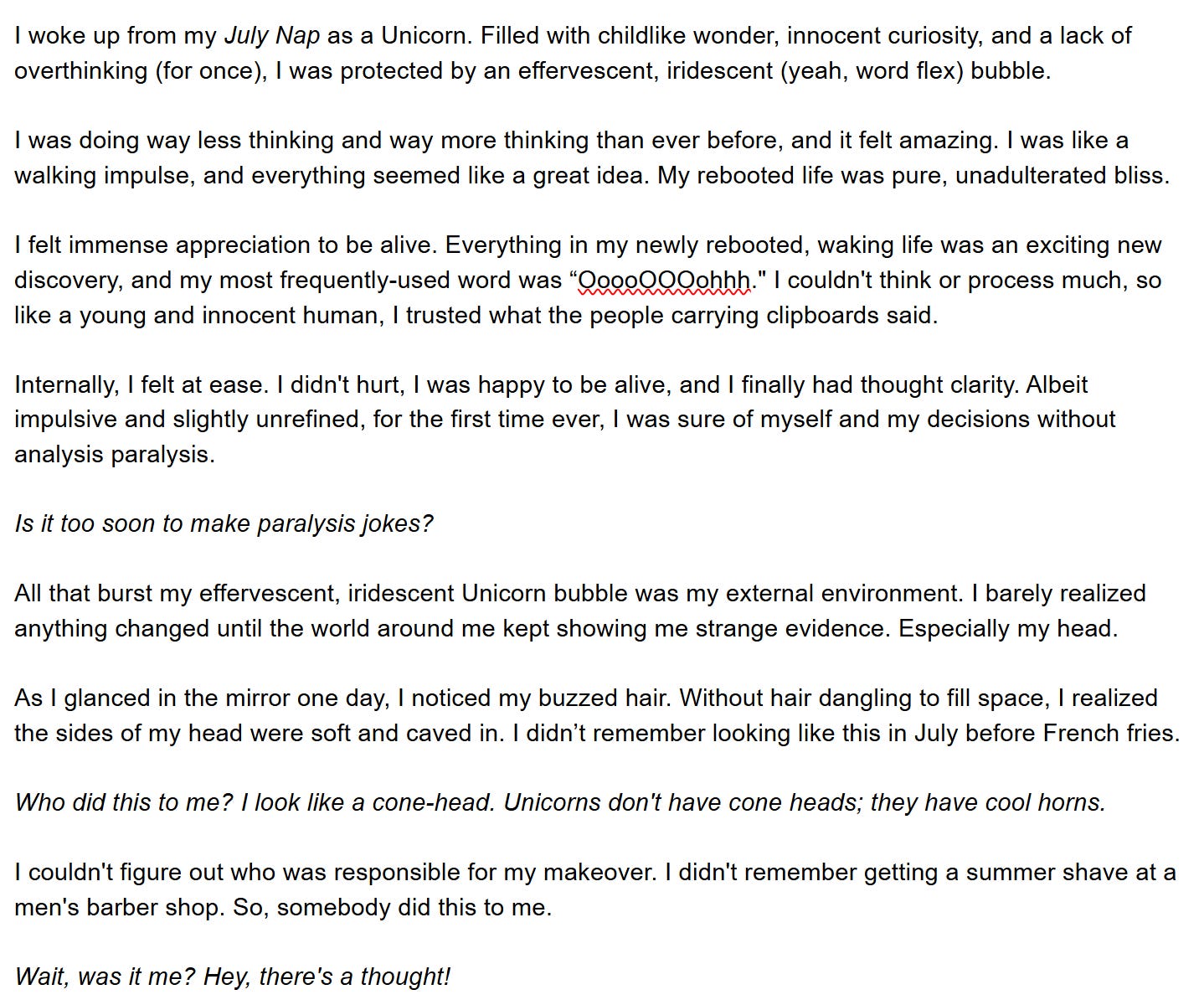
For a glimpse inside my unicorn mind, here’s a lovely blurb from my manuscript:
But wait! As my brain came back online, reality started creeping in, and I realized I needed a better strategy to preserve my inner-unicorn.
So I’ll use this moment to gently nudge all of us to protect what makes us sparkle.
Enter our ~food forethought~ today: ~asset preservation.~
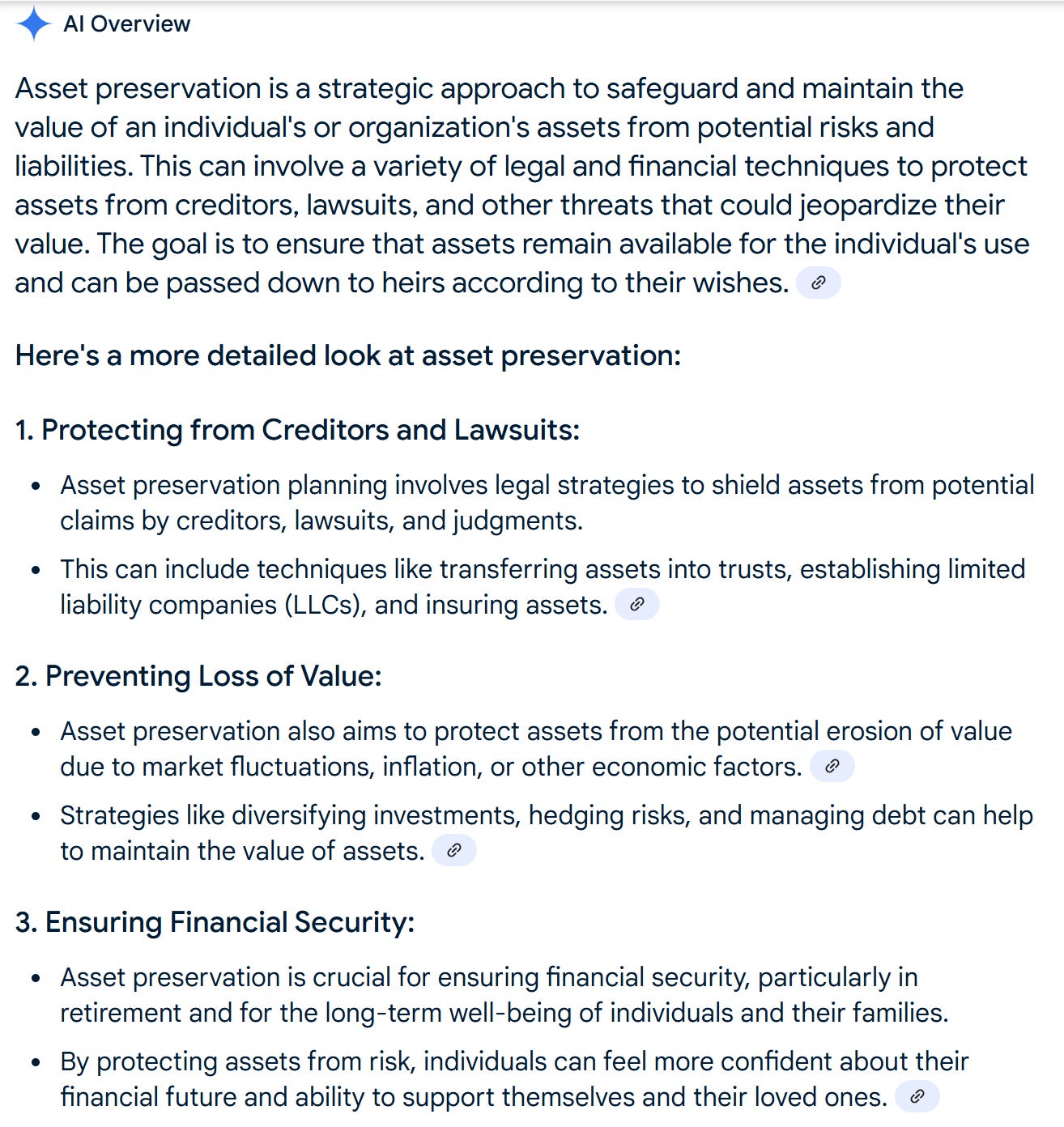
Here’s the technical definition:
While I could take us down the road of liability and legality, I won’t … due to umMm—reasons. Instead, let’s channel our inner Garmin girlies (or TomTom’s) and take the most sparkly, strategic route toward ~asset preservation.~
I vote we hop on the Neuroplasticity and Cognitive Reserve Expressway.
Why the road metaphors? Because this journey is just that—a winding, fascinating, sometimes (often) bumpy ride that is (according to me) worth the rigamarole.
Before we drive toward ~asset preservation,~ I’ll define three more key terms:
UnicornNeuroplasticity
Cognitive Reserve
Value
1. ‘Neuroplasticity’ is a fancy way to say: your brain can rebuild,
and you get to help. When a road—neural connection—is blocked or damaged (picture potholes if you’re a visual learner), the brain can construct a new one around it. A new road is built each time you learn something. In those moments, brain cells are communicating through a synapse (space) to form new neural connections.
So, neuroplasticity is road construction. Tell ya what, in ~2021, I wrote you this blurb:
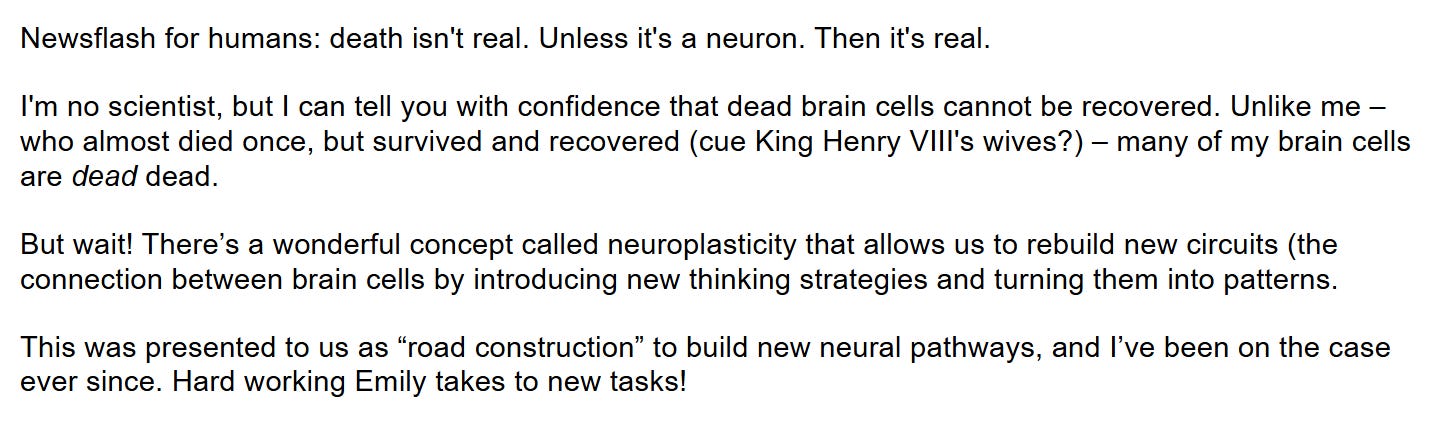
And with all that in mind, I’d rather we embrace the bumpy road to ~asset preservation~ on purpose instead of by accident like me in 2020.
**Cut to: me bouncing over Chicago potholes from the back of an ambulance.**
If the road metaphor isn’t cuttin’ it for you, I’ll give you the other way to picture neuroplasticity: an opportunity for gardening. Dead branch? Trim it. It'll grow back—stronger. Just like my grandpa used to say:
“the difference between a good and a bad hair cut? a couple of days.”
If only neural connections sprouted as fast as my baby hairs over my scars. Or looked as good as birds when they crest their crowns—aka activate their unicorn horns.


2. ‘Cognitive Reserve’ is a fancy way to say: snacks in the pantry,
full of nuggets of knowledge, waiting to be whipped into a recipe whenever life throws you a new task. Cognitive reserve is your brain’s ability to draw on deep, accumulated knowledge and experience to adapt and rebuild—even after trauma.
Technically speaking, when you take any action, you:
raid the pantry
find a nugget of knowledge
activate it
keep raiding
gather more nuggets
mix them into a recipe (aka: thought, action, feeling)
For example, to identify a bird in the wild, your brain pulls from your pantry: location, size, sound, behavior, color—all the details you've stored.
Once you’ve gathered your knowledge nuggets, your frontal lobe ‘executive functions’ kick in to organize them—and bam!! Bird named.
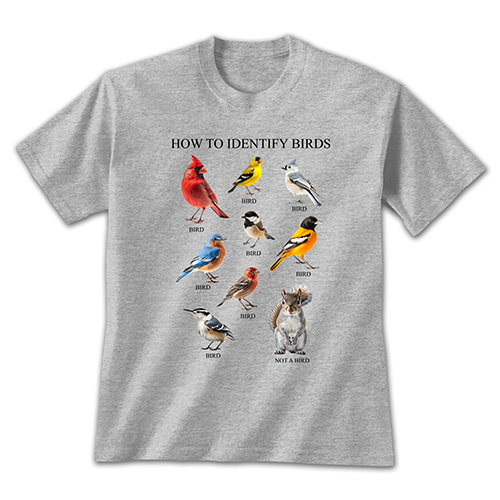
Now that we’re vibing on our fancy new vocab, let’s hop on the Neuroplasticity and Cognitive Reserve Expressway toward ~asset preservation.~
Wait! **navigation voice** Before we go further, let’s define value. And no I’m totally not triggered by that word in a…
“Hey, Emily, I know it’s 9:00 pm, but can you make a PPT on McD’s value menu for a 9:00 am exec meeting? I value your creativity. It’ll be a huge value-add to the value team.”
… type of way. Yeah, totally not triggering at all. **deep breaths**
3. ‘Value’ is a fancy way to say: stuff worth something.
I used to equate my value with physical proof of greatness—with tangible results. Lacrosse game wins. Mermaid-esque hair. Fancy job title. Awards. Blahh, blahh.
Then I had a rough run (read: a bunch of my brain cells ‘died’), and discovered something surprising—I still sparkled. I was still smart. Wiiiccckkaaaa whaaaaaat?!?
Yep. Here you go, ~2021 me had thoughts on this, too:
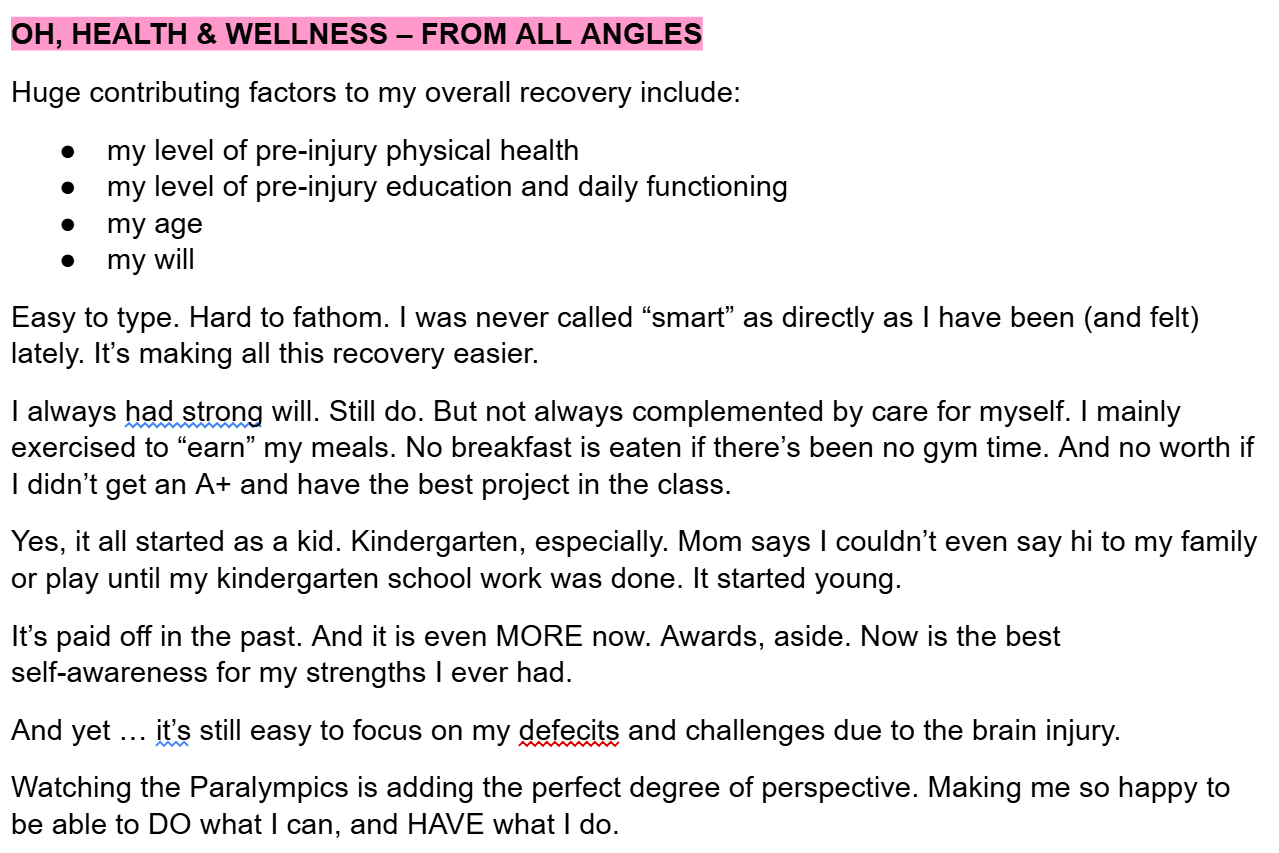
The day I realized that? Paradigm shifting. And no, it didn’t excuse me from typos. But it did inspire me to learn more about cognitive reserve and its role in my recovery.
Now that we’ve defined:
UnicornNeuroplasticityCognitive ReserveValue
… I’m ready to re-define:
~Asset Preservation~
~Asset preservation~ means recognizing the knowledge, skills, and experiences we’ve earned—reactivating them when needed, and reinforcing them with intention.
Recognize, Reactivate, Reinforce kinda vibes like Reduce, Reuse, Recycle, yeah?
So, if what we value is:
Physical – like our body:
Lifting weights, performing cardio exercises, and refueling with adequate protein will help us protect our ass-ets.Cognitive – like our ability to connect and communicate:
Protecting against memory slips with tools (and boundaries) helps us tell our story without giving all of it away—guarding our minds and our hearts.Emotional – like our stress tolerance:
Building in daily wind-up and wind-down rituals keeps our nervous system balanced and resilient**.
**Quick science detour: A recent psychiatry study shows how smart ~asset preservation~ (yes, I’m over-simplifying it) supports resilience after stress/trauma.
So unicorn preservation isn’t #JustEmilyThings. It’s neuroscience!
If you build up your cognitive reserve, it’ll build you up later. Or as mom says when we see the escalating prices on healthy groceries like kale and farm-fresh eggs:
“Pay now or pay later.”
Trust me, I’ve tested the “pay now or pay later” theory extensively since 2020. And before. I am not recommending you do the same stress/trauma test on your road construction, but I AM urging you to make strategic ~asset preservation~ moves.
That way, if stress/trauma show up (spoiler: they might will), you’ll have the best chance at bouncing back—even flying forward—if bird metaphors are your thing.
Allow this post to become the wind beneath your wings :) ooOoO there she goes with her bird business.
TL;DR — you are resilient. make good choices about how you construct your life. your sparkle is worth protecting.
XOXO,
-me
resilient me—encouraging all of us to get aHEAD of it this time